
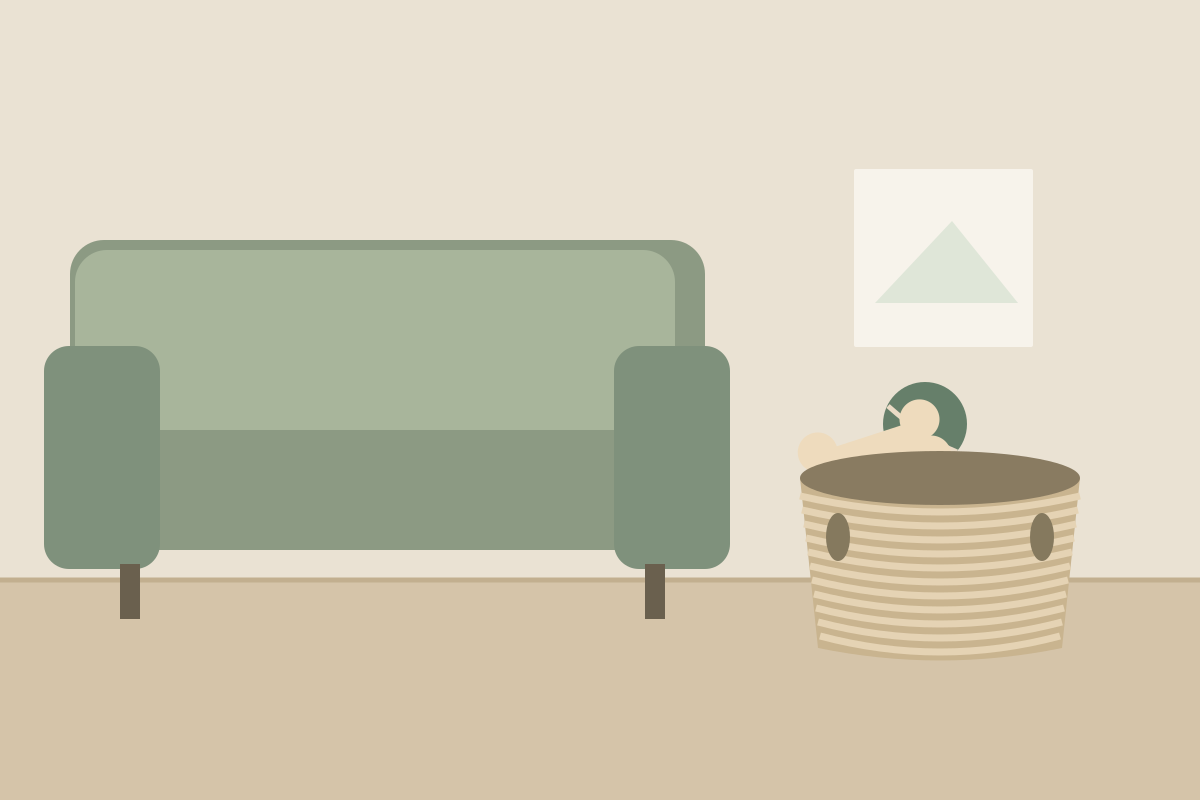
Look at where your last play session happened before buying a container. If you usually play beside the sofa, check the furniture around it rather than making room for another bin across the apartment.
These dog toy storage ideas start with three places worth trying first: a low basket, a cabinet shelf, and an ottoman you already own. Each offers a different balance of access and concealment. None requires a dog closet, and suitable storage you already have may be all you need.
Three places to check first
1. A low basket beside the sofa
Set an existing basket beside the sofa arm nearest your play area, outside the route you take through the room. Try reaching it from your usual seat and returning a toy while standing. Tucked behind the arm may look neater, but will you actually reach around it?
This is the starting point when easy access matters more than hiding every toy. For a dog allowed to choose toys, check that the rim is low enough to reach over without climbing or pulling the basket over. If your dog chews the basket or drags it into the walkway, keep the toys somewhere only you can reach.
2. One shelf inside a closed living-room cabinet
Use an available shelf in a cabinet near play when you want toys out of sight without adding furniture. Larger toys can sit directly on the shelf; an extra container is optional. Choose a shelf you can reach without emptying the space in front of it.
Open the door with the coffee table and sofa in their everyday positions. If you must slide the table aside each time, another spot is more convenient. If your dog can open the cabinet door, keep toys that need supervision somewhere else, beyond your dog’s reach.
3. An existing storage ottoman
A storage ottoman already beside the sofa gives toys a concealed home without taking more floor space. Check how you use its top before claiming the compartment. If it holds a tray of mugs and a blanket, all of those may need moving whenever you put a toy away.
Try the full sequence: clear the top, open the lid, put away a toy, and close it. A mostly clear footrest is a more practical candidate than your main coffee-table substitute. Follow the ottoman’s lid instructions, keep your dog clear while opening and closing it, and do not let the dog rummage beneath a raised lid. Choose another spot if you cannot manage the lid safely.
More places within your existing furniture
4. A low bookcase cubby
Give toys a whole available cubby so they have a defined space beside the books, without a door to open or another basket on the floor. A container can catch rolling toys; make sure it pulls through the opening rather than merely fitting inside.
5. The lower shelf of a side table
The lower shelf of an end table keeps the top free for a lamp or drink. Try retrieving a toy while seated beside it. Avoid this location if your dog pulls at the container hard enough to shift or tip the table.
6. A compartment in an entryway bench
This location makes sense when toys leave the apartment with you or the entry opens directly onto your play area. Use an available bench compartment, separate from dirty shoes. Check that retrieving toys does not block the front door. For living-room-only play down a hallway, the bench may be too far away to be useful.
7. Beneath a fixed-leg sofa
Try a shallow tray under a stationary sofa when there is no room beside it. You should be able to pull the tray into the open before retrieving toys. Keep storage out of recliners, sleeper-sofa mechanisms, and other moving furniture parts; a gap visible while the furniture is closed is not a storage compartment.
8. Under the bed in a studio
In a studio, the bed may be close to where you play, with room along one side for a long tray that will not fit beneath a smaller piece of furniture. A long tug toy may fit here when a smaller cubby is too short. Use a fixed frame, clear of moving mechanisms, and test retrieval with bedding hanging normally. Support legs can interrupt an otherwise promising space.
9. A spare drawer near play
A nightstand or desk drawer near play offers concealed storage you pull toward you. Leave enough space in front to reach the back of the drawer. The opening height matters as well as the interior: a toy can fit inside yet catch when you close it.
10. The gap between furniture and a wall
Slide a narrow existing container into a gap beside the sofa only if you can retrieve it from the front. A deep slot that requires fishing for toys from above is less useful. Leave spaces needed for cords, ventilation, or walking routes clear.
11. On top of a sideboard
For handing out toys while standing, consider a container set well back on an existing sideboard. Unlike the cabinet option, there is no door to open, although the toys remain visible and take up serving space. If your dog jumps at the container or climbs nearby furniture to reach it, choose another spot.
Vertical options for tighter layouts
12. An existing upper shelf within your reach
Use a lightweight container you can lift down with both feet on the floor. This adds storage above existing furniture without taking floor space. Move the toys elsewhere if their presence encourages your dog to climb.
13. Over-door pockets
An existing pocket organizer on an interior door gives flatter toys individual spaces when shelves are occupied. Test the pockets with the actual toys and make sure the door opens and latches normally. Follow the organizer’s fit and attachment instructions; keep it beyond reach if your dog pulls at it.
14. A pouch on an existing wall hook
Hang a small pouch where neither a shelf nor a door organizer fits. First check the hook’s installation and load instructions, and keep both pouch and handles beyond your dog’s reach. Do not assume an existing hook is suitable.
15. An under-shelf basket
An under-shelf basket leaves the shelf’s top available while using the empty space below. Repurpose one where its attachment fits, following the maker’s instructions. Doors must still close and toys lift out freely. Consider buying one only after identifying that unused gap.
Keep the location safe to use
Humane World for Animals’ toy-safety guidance emphasizes the individual dog’s needs and supervision with squeaky toys. Keep toys that require supervision where your dog cannot retrieve them independently. Check reused containers for damaged edges, loose parts, and handles your dog might chew or become caught in. Put only clean, fully dry toys into enclosed storage.
The CPSC’s Anchor It! campaign recommends anchoring furniture with drawers, doors, and shelves. Follow furniture and anchoring-kit instructions. In a rental, discuss the required installation with your landlord. If suitable anchoring cannot be installed, choose a different storage location. For attached storage, follow the maker’s surface, fit, and load requirements.
Check the fit of your chosen spot
Use the row that matches your location and record the measurements in inches in your own notes. Check the container’s outside size against the available space, then try the largest toy inside. Leave room to open or pull out the container as well.
| Your location | Measure first | Try it |
|---|---|---|
| Beside the sofa or on a sideboard | The clear width and depth, including any baseboard or shelf edge. | Put an existing container there. Reach it, return a toy, and check that it stays clear of the walking route or furniture edge. |
| Inside a cubby, cabinet, or drawer | The opening and usable inside width, depth, and height. | Retrieve the largest toy and close the door or drawer without moving nearby furniture. |
| Under the sofa or bed | The lowest clearance, including rails and support legs. | Pull the whole container out with the furniture and bedding in their normal positions. |
Try one location today
Use one suitable setup during your next play session. If putting toys away is straightforward, keep it. If something gets in the way, write down the problem before shopping. A purchase should answer a specific need, such as fitting a shallow opening; it does not need to be part of the solution.