
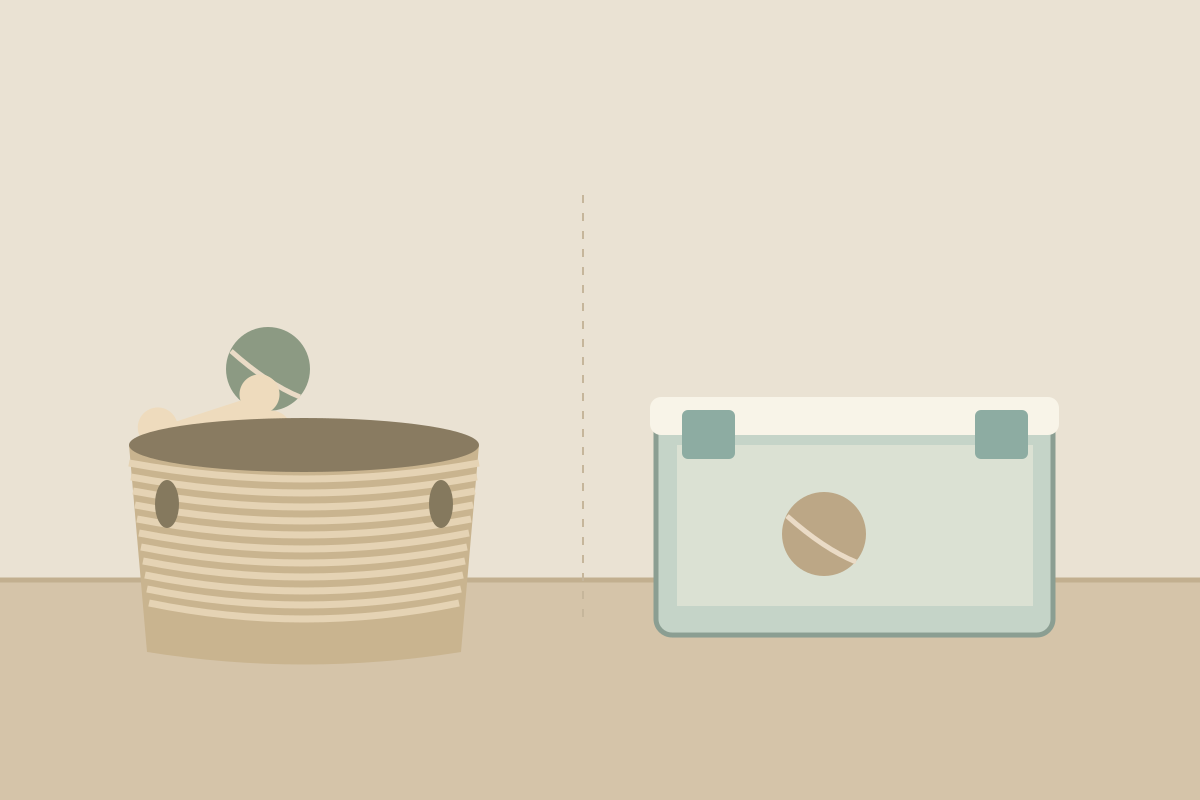
Choose an open basket for toys you take out repeatedly during the day. Choose an opaque lidded bin when you want the toys hidden and do not mind opening a lid each time. Either format can hold toys you hand out yourself, provided you keep it somewhere your dog cannot access. If you need an everyday selection and a separate reserve, two containers may be easier to manage.
Start with who will retrieve the toys and where the container will live. A lid adds a step to your routine, but it does not prove your dog cannot get inside. Decide which toys should be reachable and when you will supervise.
Open basket or closed bin? Start here
| Question | Open storage | Lidded storage |
|---|---|---|
| Who retrieves the toys? | You can reach straight in. Your dog may also retrieve toys if the container is within reach and that access is appropriate. | Plan on opening it yourself. Do not assume the lid will stop your dog. |
| Do the toys need to disappear from view? | The opening leaves toys visible. | Choose opaque sides and a lid for concealment. A clear bin still shows its contents. |
| How much effort does cleanup take? | Put toys back without moving a lid. | Allow for opening, closing, and somewhere to put a removable lid. |
| What room does it need? | Room to reach into the opening or pull the basket out. | Room to lift the lid, swing it open, or retrieve the whole bin. |
| What care should you check? | The instructions for the actual material, lining, and handles. | The instructions for the base and lid, including any lining or removable parts. |
Neither format solves a chewing or unwanted-access problem on its own. If your dog mouths the container or gets into toys that should be handed out only during supervised play, change where you store them rather than relying on a different-looking basket or lid.
Choose storage around your dog
For toys taken out repeatedly beside the sofa
An open container is the more practical starting point when you reach for a toy throughout the evening and want an easy place to return it. Keep this selection small enough that you can retrieve the toy you want without emptying everything onto the floor.
Floor-level access is a separate choice. You can use an open basket for your own convenience without giving your dog unrestricted access to it. If your dog will retrieve toys, check that reaching over the rim is comfortable and watch how they interact with the basket itself.
For toys you hand out yourself
For toys you hand out yourself, either an open basket or a lidded bin can work. Keep the container somewhere your dog cannot access between sessions. Choose opaque sides and a lid if you also want the toys out of view; choose an open basket if you prefer to reach straight in. The location needs to prevent unwanted access in either case.
Humane World for Animals advises supervising play with squeaky toys and removing toys that become torn or break into pieces. Storage should support those decisions. Putting a toy in a basket does not change whether it needs supervision.
For clean reserve toys stored away
A lidded bin is a reasonable choice for clean, fully dry toys you are not using now. Here, opening the lid occasionally may be less of a nuisance than opening it several times every evening.
Choose clear sides when seeing the reserve selection matters more than hiding it. Choose opaque storage when concealment is the goal. If everyday access and reserve storage are different jobs, split them between two containers rather than buying one oversized bin that must do both.
Choose the material separately from the lid
Open does not mean fabric, and lidded does not mean plastic. The opening tells you how you will retrieve toys. The particular container’s construction determines which care instructions you need to check.
For a woven or fabric container, look for instructions covering the whole basket, not just the fiber named in its description. A lining, handle, or insert may need separate consideration. For a rigid container, check the permitted cleaning method for both the base and any lid. Do not assume either format can go in a washing machine, dishwasher, or sink.
If frequent washing is central to your routine, make a documented cleaning method a buying requirement. A vague claim that a basket is easy to clean is not enough to tell you how to wash it. Likewise, a lid alone tells you nothing about waterproofing, odor containment, or resistance to chewing.
Dry cleaned toys before enclosed storage
Follow each toy’s care instructions, then let it dry before putting it in enclosed storage. Keep drying separate from putting toys away: an open basket filled with toys is not automatically a drying rack, and closing a lid is not a solution for damp toys.
The same distinction applies after cleaning the container. Follow its drying instructions before refilling it. Choose your storage around toys that are ready to be put away, rather than expecting the storage format to do the drying for you.
Check the fit before buying
Measure your chosen spot in inches, including its usable width, depth, and height. Compare those measurements with the exact variant’s published outside dimensions. Check whether handles or a projecting lid are included; a photograph is not a measurement.
Then check the largest toy you intend to store. Use published usable interior dimensions when they are available. Outside dimensions do not establish inside capacity, and an unknown interior measurement should stay unknown. If a particular toy must fit and the relevant measurement is missing, get that answer before ordering.
Finally, rehearse the movement. Will you lift the lid in place, set it beside the bin, or pull the entire container out? Leave room for that action and your hand. A bin that slides onto a shelf is not necessarily convenient to open there.
Two containers for different routines
CozyWa has not bought or hands-on tested these containers. The examples below use published product information: a small open basket for everyday toys and a larger lidded box for a separate reserve. Choose around the toys and space you actually have.
As an Amazon Associate I earn from qualifying purchases.
Happyiren medium woven cotton rope basket: white, one-pack
Amazon’s listing identifies this as a cotton basket sold individually, with listed dimensions of 13 inches long by 8 inches wide by 6 inches high. Its open format makes it a candidate for a small selection of dry toys you reach for beside the sofa, without buying a multipack.
Choose it for that routine, not as a chew-resistant container. Skip reachable placement if your dog mouths woven sides or handles. Usable interior dimensions and a specific washing method were not verified, so do not choose it for a must-fit toy or frequent washing without those answers.
Check current details on Amazon.
For a separate reserve: Sterilite 15-quart latching box, model 14948012
This clear-base box is a candidate when the clean, dry toys you are setting aside need more room than your everyday selection. The linked listing is for one box, and you can see what is inside before opening it. Choose it for visible reserve storage; its clear sides will not hide the toys.
The latches give you another step each time you take out a toy, which may be acceptable for an occasional reserve. Keep the box somewhere your dog cannot access; the latches are not a reason to leave supervised-play toys within reach. Follow the supplied care instructions, and check the permitted method first if frequent washing is a buying requirement.
Before ordering, check Sterilite’s dimensions; Amazon’s size table is inconsistent.
Check current details on Amazon.
You may not need to buy anything. An existing container is a better starting point if it already fits the toys, the space, your cleaning routine, and your access plan. Buy a multipack only when you have a real use for the extra containers, not simply because you need one toy basket.
Make the choice now
For repeated play beside the sofa, start with an open container you already own. For toys you hand out only at playtime, keep either type somewhere your dog cannot access. Choose opaque sides and a lid when you also want the toys hidden. Add a separate reserve bin only when you have clean, dry toys that need one. Buy to solve the remaining problem, not to replace storage that already works.