
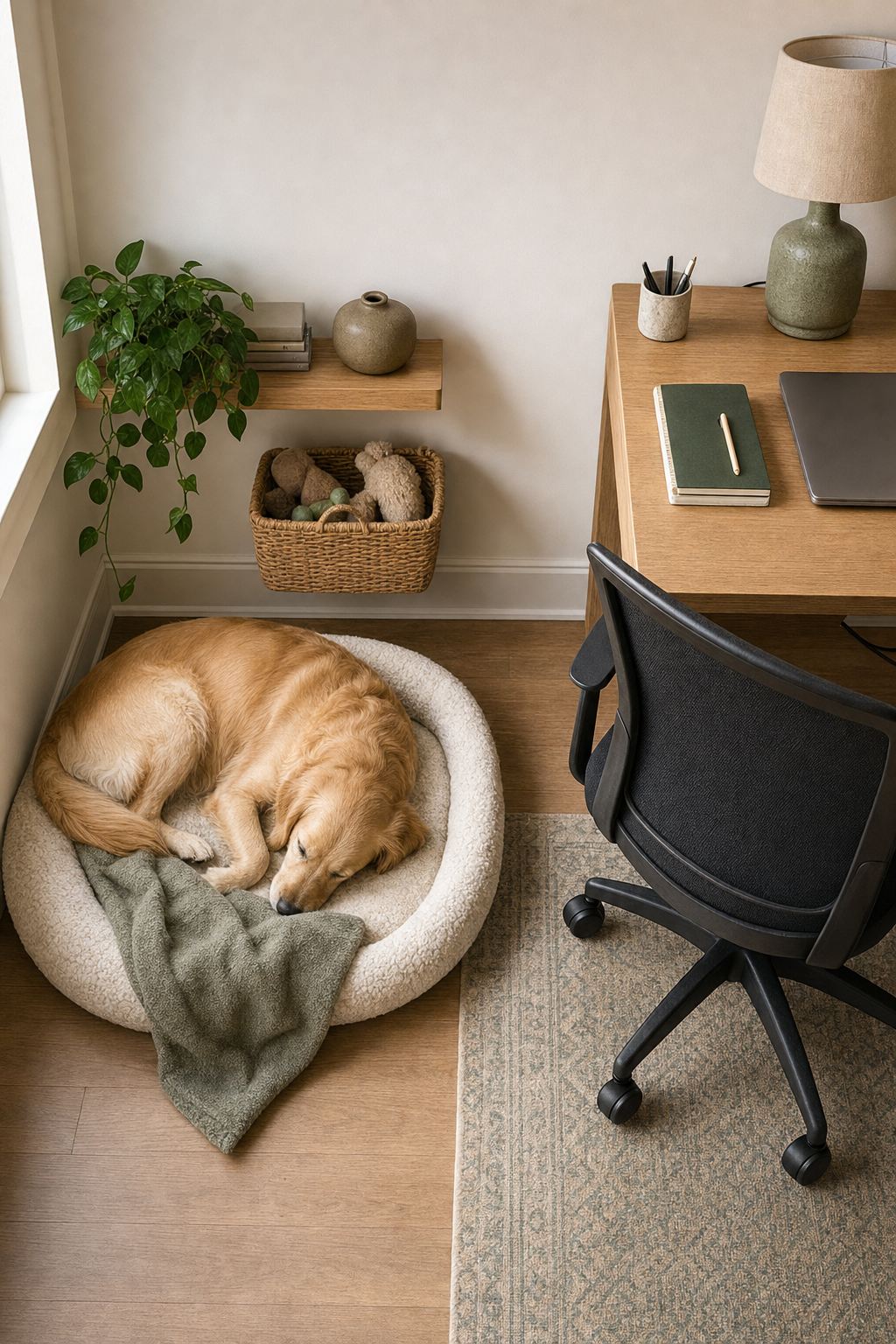
No extra room? Give your dog a resting spot within a room you already use: beside the sofa, along a bedroom wall, or in a quiet part of your home office. These small dog corner ideas are about using a small space, not squeezing every dog into a small bed. Start with the roomiest workable layout, then add only the storage you need.
Fit the dog first, then choose the corner
Watch how your dog sleeps. The RSPCA recommends enough bed space for natural sleeping positions, including stretching out. Compare your dog’s resting shape with the usable sleeping area, not just the bed’s outside dimensions. Bolsters take up space. Never buy a smaller bed simply to fit a gap.
Look for a quiet, dry, draft-free place where your dog can rest undisturbed. Keep vents clear and leave an easy route to water; the ASPCA advises keeping fresh water available at all times. Open doors and move chairs through their normal range before deciding. The U.S. Fire Administration says doors and windows must not be blocked.
| What you have | Ideas to consider | Main check |
|---|---|---|
| Open floor beside living-room furniture | 1, 2 | Bed and toys stay outside the walking route. |
| A sofa away from the wall | 3 | The space behind it is not a passage. |
| A reading corner or open console | 4, 5 | Furniture does not crowd the dog. |
| A home-office nook | 6 | The chair and cords stay separate. |
| Available bedroom floor | 7, 8 | Nighttime routes remain clear. |
| A dining-room edge or studio | 9, 10 | Daily activity leaves the bed undisturbed. |
| A recessed entry alcove | 11 | It sits entirely outside the exit route. |
| Room for a bed but not supplies | 12 | Move storage, not the dog’s resting space. |
Living-room layouts that share the space
1. Make a sofa-end sleeping nook
Place the bed beside one sofa arm, with its open side facing the room. This keeps your dog near the seating area without putting the bed between the sofa and coffee table. Replacing an unnecessary end table may create the space. Check the sofa’s moving parts first, especially a reclining seat or pullout section.
As an Amazon Associate I earn from qualifying purchases.
These recommendations are based on published information. CozyWa has not tested the products firsthand.
If you need a bed for this sofa-side spot, consider the FurHaven medium L-shaped chaise bed in Stone Gray. Amazon lists its outside dimensions as 30 × 20 × 6 inches and describes a removable, washable cover. Before choosing this medium size, confirm that your dog can stretch out within the bolsters; the full footprint includes those raised edges. Remove the cover for cleaning and follow its care label.
As an Amazon Associate I earn from qualifying purchases.
Medium-dog sleeping zone
FurHaven medium L-shaped chaise dog bed, Stone Gray
A Medium L-shaped chaise bed to compare against both your dog’s sleeping space and the room’s available floor area.
Good fit for: A sleeping setup where the selected Medium’s 30 × 20-inch footprint and listed 26.5 × 16.5-inch sleeping area fit your measurements.
Consider before buying: Measure your dog’s natural sleeping position, including legs, and recheck the selected size chart. Listed height and foam details vary; do not infer entry height. A removable washable cover does not mean the insert or whole bed is washable.
View on Amazon (opens in a new tab) ↗FurHaven says its beds are not chew-resistant, so this is not a solution for a dog that chews bedding.
2. Pair a wall-side bed with a small toy station
Run the bed along an unused living-room wall and place a separate basket at one end, not across the dog’s entrance. Keep the resting surface free of toys. This arrangement works when both items fit without making people sidestep them.
The Happyiren white cotton rope basket gives a few everyday toys their own spot beside the bed. Amazon lists this single basket at 13 × 8 × 6 inches. Its open top makes it easy to put clean, dry toys away after play. Check the inside space against your longest toy before ordering, and keep the basket out of reach if your dog chews rope or handles.
As an Amazon Associate I earn from qualifying purchases.
Open toy storage
Happyiren WB-WE cotton rope basket, white, 1-pack
An open cotton-rope basket for a small selection of dry toys beside the sofa.
Good fit for: Everyday toys you want to keep easy to reach, in a spot suited to your dog and your routine.
Consider before buying: Keep it beyond reach if your dog mouths woven sides or handles. The listing gives outside dimensions of 13 × 8 × 6 inches; confirm usable interior space and exact care instructions before buying.
View on Amazon (opens in a new tab) ↗For toys you hand out yourself, compare open baskets and lidded bins and choose a storage spot your dog cannot reach.
3. Use the quiet side behind a freestanding sofa
In an open-plan living room, a sofa placed away from the wall may leave a usable area behind its back. Position the bed parallel to the sofa, with an unobstructed approach from the side. Use this only when that area is not the route between rooms. Do not push the sofa toward the bed until the dog is confined to a narrow slot.
4. Share a reading corner
Trade a second side table or decorative floor basket for a dog bed beside a stationary reading chair. Angle the bed toward the open room so you can stand up without stepping over it. Keep the lamp and its cord away from the resting area. A rocking chair or expanding footrest needs a different arrangement.
5. Tuck the bed beneath an open console
An existing open console can share its footprint with a bed, but the furniture must suit the dog—not just hide the cushion. Allow room above the bed for your dog to stand, turn, and leave freely. Keep the front open and air circulation unobstructed.
Follow the furniture maker’s placement and securing instructions. Do not remove a shelf, stretcher, or structural support to create an opening. A tight console bay is a reason to choose another layout.
Bedroom and workday layouts
6. Set up beside the desk, outside the chair zone
Place the bed along the outer side of your desk rather than beneath your feet. Leave the full chair-roll area separate, including where you push back to stand. Route charging cables away from the bed, and check any moving desk components. This gives a dog that already settles near you a defined spot without turning your legroom into a sleeping area.
7. Give the bedroom a bedside resting spot
Use the side of your bed with enough floor space for both the dog’s bed and your normal nighttime route. Keep it out of the place where your feet land when you get up. Open the closet and bedroom doors fully during the check. There is no need to add toy storage here when sleep is the main purpose.
8. Replace a foot-of-bed bench
Removing a decorative bench can make room for a properly sized dog bed at the foot of your own. Place it parallel to the mattress and preserve access around it. Test the arrangement while carrying laundry and opening nearby drawers. If you must step over the dog to leave the room, the bench’s old location is not a workable replacement.
Other ways to use the rooms you have
9. Claim an unused dining-room wall
A dining area may have a quiet wall beyond the table’s working space. Put the bed there, not underneath a chair. Pull out every seat as someone would when sitting down or leaving; include extension leaves you regularly use. Choose another location if meals and cleanup would repeatedly disturb the resting spot.
10. Define a studio zone without adding a divider
In a studio, position the dog bed at the edge of the living area, alongside an existing rug rather than in the route to the kitchen or bathroom. The bed itself defines the zone; it does not need a screen or enclosure. Keep the whole bed supported on an even surface instead of straddling a raised rug edge.
11. Use a recessed entry alcove, not the hallway
A genuine recess beside the entry can work when the full bed sits beyond the doorway and walking route. Move shoes and bags elsewhere so they do not encroach later. Reject this option if opening the door brings drafts across the bed or frequent arrivals prevent quiet rest. An exit passage is not spare floor space.
12. Split the sleeping corner from the supply station
When a comfortable bed fills the available corner, let it have that space. Keep the bed in a quiet bedroom or living-room spot and store toys in another room’s existing cabinet or suitable shelf. This is especially useful when a larger dog’s bed leaves no sensible place for a basket. Explore dog toy storage ideas for small apartments for the separate supply location.
Choose a layout, then add what is missing
Pick the arrangement that preserves your dog’s full resting area and your household’s routes. Measure the available space, check doors and moving furniture, and reuse a suitable bed or container you already own. When something is missing, revisit the FurHaven bed in idea 1 or the Happyiren basket in idea 2 and check the relevant size and use limits before ordering. Move optional storage before sacrificing sleeping space.