
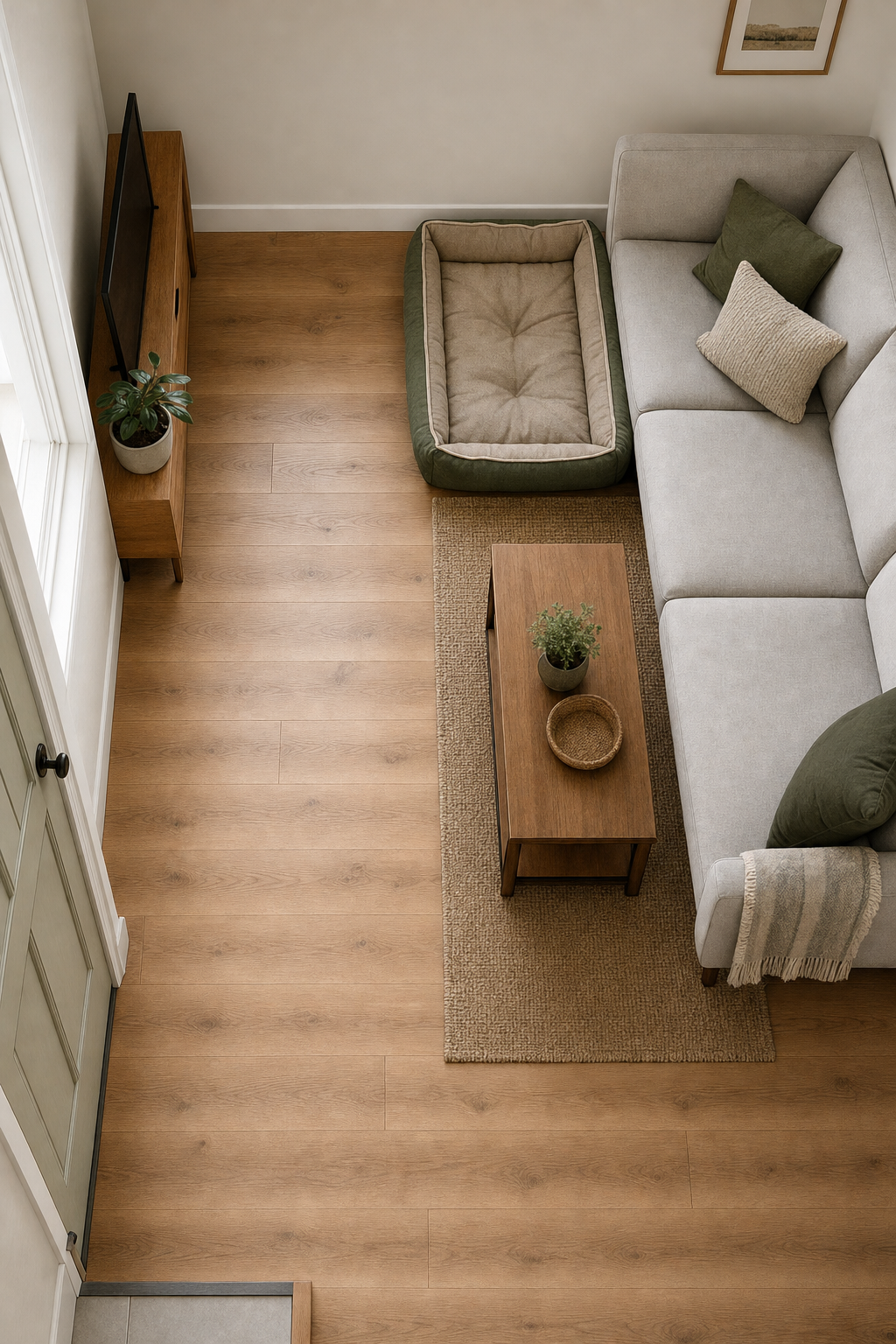
Start beside the quieter end of the sofa, outside the route from the doorway to the seats. Treat that as a place to test, not a rule: the bed must fit your dog, people must be able to pass, and doors and moving furniture must work without touching it.
Use your dog’s current bed first if it already suits them. You may need to move an end table, not buy a smaller bed.
1. Check the space your dog needs to sleep
Watch your dog resting in different positions before measuring the room. Record the length and width they occupy when comfortably stretched out, including their paws. Do not measure only a tight curl. The RSPCA’s bed guidance recommends enough room for a dog’s natural sleeping positions, including stretching out.
On an existing bed, check whether your dog can change position without being wedged between raised sides. For a replacement, compare their measurements with the usable sleeping surface, not just the size printed in the product title. Raised bolsters occupy part of the bed’s outer rectangle.
2. Measure the sofa-side space in separate parts
Measure with the room arranged as you actually use it. Include projecting sofa feet, the base of a floor lamp, and any furniture opposite the proposed bed. Record these measurements in inches in a notebook or phone note.
| Measurement | What to record and check |
|---|---|
| Your dog’s lying space | Length and width in their relaxed sleeping positions. Use this to check the sleeping surface. |
| Usable sleeping surface | Flat length and width inside any bolsters. Do not count raised sides as flat lying space. |
| Full bed footprint | Outside length and width, including bolsters. This entire rectangle must fit on the floor. |
| Sofa-side space | Available length beside the sofa and distance out toward the next obstacle. Check both bed orientations. |
| Passing space | Narrowest remaining gap beside the full bed. Record it separately and test it during ordinary movement. |
Do not count the walking route as spare bed space. Also check the room needed to open a nearby drawer, retrieve a basket, or lift the bed for cleaning. Those movements can cross an otherwise empty-looking patch of floor.
A sofa-side option when the medium size fits your dog
As an Amazon Associate I earn from qualifying purchases.
This selection uses published product information. CozyWa has not tested the product firsthand.
The FurHaven medium L-shaped chaise dog bed in Stone Gray is worth considering for an open-floor spot beside the sofa. Amazon lists a 30 by 20-inch floor footprint; the medium row of its size chart gives a 26.5 by 16.5-inch sleeping surface. Compare your dog’s lying measurements with that smaller rectangle and stay within the listing’s 35-pound weight recommendation. Try the bolstered sides toward the sofa or wall, with an open edge your dog can approach.
Amazon describes the removable cover as machine-washable. Remove the cover and follow its care label; the insert needs its own care instructions. FurHaven’s FAQ says its beds are not chew-resistant, so this is not a solution for a dog that chews bedding.
As an Amazon Associate I earn from qualifying purchases.
Medium-dog sleeping zone
FurHaven medium L-shaped chaise dog bed, Stone Gray
A Medium L-shaped chaise bed to compare against both your dog’s sleeping space and the room’s available floor area.
Good fit for: A sleeping setup where the selected Medium’s 30 × 20-inch footprint and listed 26.5 × 16.5-inch sleeping area fit your measurements.
Consider before buying: Measure your dog’s natural sleeping position, including legs, and recheck the selected size chart. Listed height and foam details vary; do not infer entry height. A removable washable cover does not mean the insert or whole bed is washable.
View on Amazon (opens in a new tab) ↗3. Sketch the bed beside the route, not across it
Draw the sofa, nearby table, doors, and the route people take through the room. Add the bed’s full footprint, then mark the smaller sleeping surface inside it. Keep the passing space outside both.
surface
C: Passing space
Here, the bed sits beside a sofa end rather than between the sofa and coffee table. The door-to-exit route runs outside the bed. On your own sketch, add door-opening arcs and a separate path to your usual seat; a clear route through the room does not automatically mean every seat is easy to reach.
For a straight gap, subtract the bed’s projection into the room from the distance to the opposite obstacle. The remainder is passing space, not a universal clearance target. Test that space with the people, mobility aids, and everyday items that actually move through your home.
4. Keep the walking route open in everyday use
With your dog away from the test area, put the existing bed in position. Open nearby doors and drawers fully, and check any recliner or sofa-bed movement. Keep the bed outside the furniture’s entire moving area, not just clear of its closed position.
Walk from the doorway to each seat and onward to the exit. Try carrying a laundry basket or using your usual mobility aid. Can you pass without turning sideways, stepping over the bed, or moving it? Include the space your dog occupies when getting up, not just the empty bed.
Keep exits and vents unobstructed, and leave a usable route to the water bowl. The RSPCA recommends constant access to clean drinking water. Moving the bowl out of the walking route should not put it somewhere your dog cannot readily reach.
5. Adjust the first spot when it fails a check
People keep brushing past the bed
Try turning the bed or moving a small table before choosing a different bed. Repeat the route test after each change. If the full footprint still intrudes, test another room edge; do not fold or compress the sleeping surface to make the layout work.
Your dog keeps choosing another place
Notice what happens around the proposed spot: footsteps, television sound, a draft, or frequent attention. Try a quieter position nearby. The RSPCA suggests a draft-free resting place and options that allow both undisturbed rest and time near the family. A living-room bed need not be your dog’s only resting place.
The bed fits only when a cabinet stays closed
Move the stored items, the cabinet, or the bed. If getting a blanket means dragging the bed into the walkway every evening, that location has not passed the practical test. Check that you can remove the cover and clean underneath without dismantling the corner.
6. Try the arrangement during a normal evening
Use the room normally and let your dog choose whether to settle. A bed is a resting place, not containment. Watch whether they can approach it, change position, get up, and reach their water without squeezing around furniture. Ask everyone to leave the dog undisturbed while resting.
Notice where the bed ends up by the end of the evening. If it has shifted into the walking route, adjust the spot and try again. It should also be easy to lift for cleaning without moving half the furniture.
Keep a suitable existing bed when the arrangement works. When you need a replacement, return to the FurHaven size and fit check only after both your dog’s measurements and the room test support it. Otherwise, use the measurement worksheet to test another location before buying.